

Welcome to the 15th Special Issue of Magic Powder!
In this edition, we celebrate the remarkable strides and collaborative achievements of the catalysis community, showcasing the dynamic intersection of science, innovation, and perseverance. The 10th National Catalysis Conference (NCC-10), held at Sivas Cumhuriyet University, brought together leading researchers to explore cutting-edge topics—from sustainable hydrogen production and CO₂ conversion to the transformative role of machine learning in catalyst design. We spotlight the pioneering work of the Sabancı University Energy Storage and Conversion Group, whose breakthroughs in hydrogen technologies, fuel cells, and advanced battery systems are paving the way for a cleaner energy future.
Beyond the science, this issue shares the inspiring personal journey of Tuğba Gürbüz, whose dedication to both her son’s health and her academic research exemplifies resilience in the face of adversity. We also highlight recent advancements from Türkiye’s catalysis community, featuring innovative studies on NH₃ decomposition, electrocatalysts, and photocatalytic hydrogen production.
As we reflect on the past and look to the future, we invite you to explore the wisdom of catalysis, engage with our crossword puzzle, and mark your calendars for upcoming events like the 16th EuropaCat Conference and the National Chemistry and Chemical Engineering Congresses. Together, we continue to break barriers, foster collaboration, and drive the catalytic innovations that will shape tomorrow’s world.
The Catalysis Society
Editorial Board
Prof. Dr. Ayşe Nilgün AKIN
Prof. Dr. N. Alper TAPAN
Dr. Merve DOĞAN ÖZCAN
Asst. Prof. Dr. Elif CAN ÖZCAN
Dr. Mustafa Yasin ASLAN
Reflections On NCC-10 Held In Sivas Cumhurİyet University
The 10th National Catalysis Conference (NCC10), held from June 25 to 28, 2025, at Sivas Cumhuriyet University, marked a significant milestone for the catalysis research community in Türkiye. Organized by Prof. Ayten Ateş from Sivas Cumhuriyet University and supported by the Turkish Catalysis Society, this prestigious scientific gathering brought together around 100 participants, including leading academics, early-career researchers, and professionals from industry and research institutions. The event offered a dynamic and comprehensive forum to share state-of-the-art research, establish collaborations, and explore the evolving frontiers of catalysis and chemical reaction engineering.

The conference opened with a full-day School of Chemical Reaction Engineering, organized by Prof. Ahmet Kerim Avcı and designed specifically to provide foundational training to graduate students and young scientists entering the field. Prof. Ahmet Kerim Avcı and Prof. Zeynep İlsen Önsan from Boğaziçi University, Prof. Deniz Üner from Middle East Technical University, Prof. Can Erkey from Koç University, Prof. Christopher Hardacre from Manchester University and Prof. Dmitry Murzin from Åbo Akademi University were the lecturers at School of Chemical Reaction Engineering. This educational initiative featured in-depth lectures on catalyst design, reaction kinetics, reactor engineering, and surface science, fostering active interaction between students and nationally and internationally recognized experts.
The main conference program, held over the subsequent three days, was conducted entirely in English and included a rich selection of plenary lectures, oral sessions, and vibrant poster presentations.
Among the conference highlights was the outstanding lineup of invited speakers. Prof. Christopher Hardacre from the University of Manchester delivered a powerful plenary lecture on plasma catalysis for net-zero emission technologies, setting the tone for discussions around sustainable chemical processes. Prof. Dmitry Murzin from Åbo Akademi University presented his work on catalytic strategies for producing sustainable aviation fuels from biomass-derived feedstocks. Prof. Marcus Rose (TU Darmstadt) delivered a compelling lecture titled “Catalysis for the Transformation of Chemistry – Nexus of Catalyst and Process Design,” emphasizing the critical interplay between catalyst development and process engineering.
Prof. Andreas-Neil Unterreiner (Karlsruhe Institute of Technology) presented insightful results on the application of femtosecond absorption spectroscopy to investigate elementary reaction mechanisms of molecules in complex environments. Prof. Lutz Ackermann (University of Göttingen) showcased recent advances in selective C–H activation, highlighting their potential for enabling more sustainable strategies in organic synthesis.

Turkish invited speakers also played a central role, with impactful presentations from Prof. Saim Özkar on colloidal metal catalysts, Prof. Emrah Özensoy on photocatalysis for smart buildings, Prof. Ayşe Bayrakçeken on electrocatalysis, Prof. Tuğrul Çetinkaya oxygen redox catalysis in Li ion batteries, Assoc. Prof. Ali Can Kızılkaya on carbon dioxide utilization and Assoc. Prof. Oluş Özbek on methanol formation and decomposition.
Poster presentations formed a crucial part of the scientific exchange at NCC10, especially for early-career researchers. Over 30 posters were displayed throughout the event, showcasing innovative experimental and theoretical work from across Türkiye and abroad. Best Poster Awards were presented to outstanding contributions by young scientists, with selection criteria focusing on scientific quality, originality, and clarity. These awards underscored the conference's commitment to supporting emerging talent and fostering an inclusive academic environment.

Beyond the scientific content, NCC10 offered attendees the opportunity to engage with the cultural and historical heritage of Sivas. Conference participants visited iconic landmarks such as the Gök Medrese, the Çifte Minareli Medrese, and the Sivas Congress Building—each a testament to the city’s rich Seljuk and early Republican history. A gala dinner featuring local cuisine and music provided a warm, collegial atmosphere for informal networking and celebration of shared scientific achievements.
At the conclusion of the event, the organizers expressed gratitude to all contributors and highlighted plans to publish a collective review summarizing the major research themes and outcomes presented during the conference. Board of Directors of Catalysis Society also expressed their gratitude to Prof. Ayten Ateş and her team for their excellent hosting and successful conference organization. The success of NCC10 not only reaffirmed Türkiye’s growing role in global catalysis research but also reinforced the importance of creating forums that bridge fundamental science, industrial relevance, and international collaboration. As the catalysis community looks toward the future, the momentum from NCC10 provides a strong foundation for the next gathering, NCC11, anticipated in 2027. For those who attended, NCC10 was more than a conference—it was an inspiring and unifying experience that reflected the vitality and forward-looking spirit of catalysis science in Türkiye and beyond.
Scientific topics presented at NCC10 reflected the growing interdisciplinarity of catalysis research. Themes ranged from heterogeneous and homogeneous catalysis to cutting-edge areas such as electrocatalysis, photocatalysis, plasma-assisted reactions, and computational catalyst modeling. Particular emphasis was placed on sustainable catalysis approaches, CO₂ conversion technologies, and in situ/operando spectroscopy methods that are transforming how researchers understand catalyst behavior under realistic operating conditions.

Sabancı University Energy Storage and Conversion Group
Assoc. Prof. Dr. Alp Yürüm & Prof. Dr. Selmiye Alkan Gürsel
Sabancı University’s Energy Storage and Conversion Group (SU-ESC), co-led by Assoc. Prof. Dr. Alp Yürüm and Prof. Dr. Selmiye Alkan Gürsel in the Faculty of Engineering and Natural Sciences, pursues an integrated vision at the crossroads of catalysis, materials science, and electrochemical engineering. SU-ESC’s work centers on two synergistic pillars—heterogeneous catalysis for hydrogen technologies and advanced electrochemical energy storage—underpinned by nanostructured material design. By combining engineering principles, tailored synthesis, and device-level experimentation, the group spans the full spectrum from fundamental mechanisms to scalable system prototypes.
Hydrogen Production:
Hydrogen production is at the heart of the clean-energy transition: about 100 million tonnes of hydrogen are produced globally each year, yet more than 95 % still relies on fossil-fuel reforming, emitting a tremendous amount of CO₂. To meet the IEA’s goal of 49 million tonnes of renewable (“green”) hydrogen by 2030, catalysts must operate efficiently under variable renewable power, resist impurity-induced deactivation, and function at lower temperatures and pressures. Innovations in photocatalytic and electrochemical water-splitting—capable of converting solar or wind electricity into hydrogen without CO₂ by-products—are therefore industrial imperatives, not academic curiosities.
Prof. Yürüm’s expertise in heterogeneous catalysis drives his exploration of titanium-dioxide-based nanostructures—anchored on carbonaceous supports—designed to degrade emerging water pollutants through photocatalysis and to act as solar-to-chemical converters. Their recent review in Global Challenges meticulously surveys photocatalytic hydrogen-generation strategies, highlighting design principles that enable future breakthroughs. Computational modeling of catalyst–support charge-separation dynamics further refines the design of resilient photocatalyst architectures capable of long-term operation. Crucially, SU-ESC’s work has revealed that the photocatalytic and photoelectrochemical behavior of catalysts is strongly facet-dependent. Moreover, differences in facet-dependent Fermi level and flat-band potentials directly govern reduction activity, demonstrating how tailored facet engineering can optimize ion adsorption, bandgap structure, and overall long-term catalyst performance.
Hydrogen Storage:
Safe, high-density hydrogen storage under near-ambient conditions is a key bottleneck for hydrogen mobility. The U.S. Department of Energy’s ultimate targets call for materials achieving at least 2.2 kWh/kg system gravimetric capacity and 1.7 kWh/L volumetric capacity at pressures below 100 bar and temperatures between –40 °C and +85 °C. Yet no existing storage medium—compressed gas, liquid, or solid sorbent—meets these combined metrics without compromising kinetics, safety, or reversibility. Rapid uptake and release cycles, long-term cycling stability, and minimized thermal management are non-negotiable for on-board vehicle applications, driving the need for nanostructured sorbents and hybrid composites.

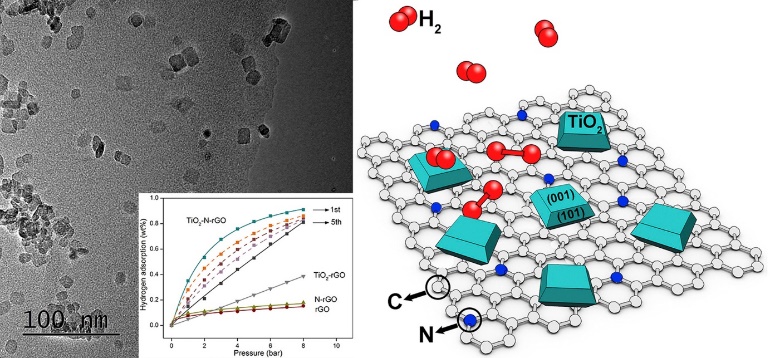
In parallel, SU-ESC addresses hydrogen storage by developing TiO₂ nanostructures, metal–organic frameworks, and graphene-supported metallic hybrids that provide both high gravimetric capacity and fast kinetics. Notably, their work on homogeneously distributed TiO₂ nanoparticles with {001} reactive facets grown on nitrogen-doped reduced graphene oxide (N-rGO) sheets achieved high hydrogen uptake at room temperature— giving the highest value reported for graphene-based nanocomposites under low-pressure conditions. This nanocomposite also retained its capacity over adsorption–desorption cycles, thanks to the synergistic combination of reactive {001} facets, uniformly dispersed TiO₂ particles, and strong polarized C–N bonding with the N-rGO support. These studies rigorously tune surface chemistry and pore architecture to optimize adsorption dynamics, demonstrating materials that not only uptake hydrogen efficiently but also maintain reversible performance suitable for on-board vehicle applications.
Fuel Cells:
Proton-exchange membrane fuel cells (PEMFCs) convert hydrogen to electricity with 40–60 % efficiency and zero tailpipe emissions, offering a direct route to decarbonize transport and distributed power. However, platinum-group metals (PGMs) account for up to 10-40 % of stack cost, and membrane durability under real-world cycling must exceed 8,000 hours to be commercially viable. Lowering PGM loading by an order of magnitude while preserving activity, engineering high-performance electrodes with optimized ionic and mass transport, and ensuring long-term operational stability are therefore essential for PEMFCs to achieve broad adoption.
Prof. Gürsel focuses on proton-exchange membrane (PEM) fuel cells, seeking to reduce reliance on platinum-group metals (PGMs). The group has developed iron–nitrogen–carbon (Fe–N–C) catalysts with ceria additives that with a promising activity and exceed durability targets. These are incorporated into electrodes created via electrospinning, producing thin yet highly active electrodes with engineered porosity. SU-ESC’s excellence in this field led to representation in European and domestic consortia.

Li-Ion and Li–Sulfur Batteries:
Lithium-ion batteries currently dominate portable electronics and electric vehicles, with over 7.9 TWh of global manufacturing capacity in 2025 and practical energy densities around 250 Wh/kg. Yet future applications—grid stabilization and electric aviation—demand densities exceeding 350 Wh kg⁻¹, rapid charging in minutes, and cycle lives beyond 5,000 cycles. Li–sulfur batteries promise theoretical energy densities above 500 Wh kg⁻¹ but are plagued by polysulfide-shuttle and poor cycle stability, requiring novel electrode designs and interlayer strategies.
In battery research, SU-ESC advances Li-ion and Li–sulfur chemistries by engineering electrode architectures—ranging from single-crystal metal-oxide nanostructures to Mxene-enhanced composites—and rigorously characterizing their electrochemical properties and cell-level performance. For Li-ion systems, the group pioneered the first electrospinning of titania-based nanotubular materials into a self-standing PVDF fibrous network. They created flexible electrodes that omit metallic current collectors—boosting overall energy density. Electrospun electrodes retain the highest specific capacity among the variants tested, demonstrating both high capacity and excellent cycle stability. Concurrently, SU-ESC tackles Li–S battery challenges by introducing free-standing nanofiber interlayers. Post-stabilization and carbonization treatments embed ultrafine TiO₂ and a thin SiO₂ surface layer within the carbon matrix, which intercepts polysulfide shuttling. When placed between the sulfur cathode and separator, these interlayers raise the cycle life by adsorbing and converting lithium polysulfide intermediates, thereby minimizing capacity fade and preserving Coulombic efficiency.

SU-ESC’s collaboration initiatives are extensive and multidimensional, positioning the group at the heart of both national and European clean-energy networks. Since 2017, SU-ESC has served as Sabancı University’s lead within the TÜBİTAK-supported N.ERGHY network, linking Türkiye to the Fuel Cells and Hydrogen Joint Undertaking and helping to shape continental research priorities. In parallel, the group contributes to the EU Horizon Europe “Hydrogen Valley – South Marmara Hydrogen Shore” project, which is laying the groundwork for Türkiye’s first hydrogen hub. Beyond these consortia, SU-ESC is part of ambitious research programs: under the M-ERA.NET-funded LIBASED initiative (Li-Ion-Supercapacitor Hybrid Energy Storage Devices), the group developed hybrid cells that merge Li-ion energy density with supercapacitor power density and cycle lifetimes; beginning 2024, the TÜBİTAK 1001-supported “DFT İle Desteklenen Fotokatalitik Radikallerin IrO₂ Temelli OER Sistemindeki Etkisi ve Yeni Mekanizmaların Keşfi” project—also coordinated by Assoc. Prof. Dr. Yürüm employs density functional theory and operando techniques to uncover how photogenerated radicals interact with IrO₂ surfaces during oxygen evolution, revealing new mechanistic pathways for water splitting. Complementing these flagship efforts, SU-ESC’s SUNUM-backed projects span 2021–2025 polysulfide-conversion studies for Li–S batteries, 2022–2025 development of PGM-free electrospun fuel-cell electrodes, all reinforcing the group’s commitment to bridging fundamental science with real-world energy solutions.
Through its unique confluence of catalysis, nanomaterials, and systems engineering—supported by robust national and international partnerships—SU-ESC stands as a leading force in advancing low-carbon energy technologies in Türkiye and beyond.

References:
1) Battelle Memorial Institute. Manufacturing Cost Analysis of PEM Fuel Cell Systems for 5‑ and 10‑kW Backup Power Applications. U.S. Department of Energy; October 2016. DOE Contract No. DE‑EE0005250.
2) Thompson ST, Papageorgopoulos D. Platinum group metal‑free catalysts boost cost competitiveness of fuel cell vehicles. Nat Catal. 2019;2(7):558‑561. doi:10.1038/s41929‑019‑0291‑x
3) McKerracher C. China already makes as many batteries as the entire world wants. BloombergNEF newsletter; April 2024.
4) U.S. Department of Energy, Fuel Cell Technologies Office. Materials‑Based Hydrogen Storage [Internet]. energy.gov; [cited 2025]. Available from: energy.gov/eere/fuelcells/materials‑based‑hydrogen‑storage
5) International Energy Agency. Global Hydrogen Review 2024 [Internet]. IEA; 2024.
6) Kaplan BY, Alinezhadfar M, Zabara MA, Ölmez B, Gürsel SA, Yürüm A. Hydrogen production via electrolysis: operando monitoring and analyses. Chem Catalysis. 2023;3(5):100601. doi:10.1016/j.checat.2023.100601
7) Kırlıoğlu AC, Ölmez B, Rahbarshendi F, Buldu‑Aktürk M, Yürüm A, Gürsel SA, Kaplan BY. Scalable nano‑sized Fe‑N‑C catalysts for fuel cells: evaluating the impact of iron precursors and CeO₂ addition. Mater Res Bull. 2024;179:112952. doi:10.1016/j.materresbull.2024.112952
8) Zabara MA, Ölmez B, Buldu‑Aktürk M, Kaplan BY, Kırlıoğlu AC, Gürsel SA, et al. Photoelectrocatalytic hydrogen generation: current advances in materials and operando characterization. Glob Chall. 2024;8(8):2400011. doi:10.1002/gch2.202400011
9) Advanced Materials Interfaces. 2023;—Paper on facet-dependent TiO₂ nanocrystals for Cu2⁺/Pb2⁺ photo/electrodeposition. doi:10.1002/admi.202300555
10) Kaplan BY, Yürüm A, Gürsel SA, et al. PAN/TiO₂ nanofiber interlayers to suppress Li–S polysulfide shuttle and enhance cycle life. Electrochim Acta. 2022;—. doi:10.1021/acs.energyfuels.3c00192
11) Yürüm A, Kaplan BY, Gürsel SA, et al. TiO₂–N‑rGO nanocomposite with reactive {001} facets for room‑temperature hydrogen storage. Int J Hydrogen Energy. 2016;41(50):xxxxxxxx. doi:10.1016/j.ijhydene.2016.11.069
PhD Stories
TWO THESES AT ONCE
By Tuğba Gürbüz
Every academic work carries an untold story behind the scenes. Behind the numbers, graphs, and methodologies lie silent struggles. My master’s thesis is a strong reflection of such a journey of resilience.
The path that empowered me and gave me strength wasn’t actually initiated by a goal of pursuing an academic career. It started for an entirely different reason: I was faced with my son’s undiagnosed, complex, and progressively worsening illness. Fighting this disease required love, knowledge, and patience. In our search for the best possible treatment for our son, my husband and I explored every available option. The limited treatment possibilities in Turkey led us to look abroad, eventually taking us to the United States to participate in clinical research.
Moving to the U.S. wasn’t just about relocating to a different country—it meant starting an entirely new life. Alongside the many adaptation challenges we faced upon arrival, my son’s treatment process was also incredibly demanding. It wasn’t enough to be medically eligible for clinical trials; it also required countless documents, procedures, ethics committee approvals, and a waiting period that often tested one’s patience. All these difficulties gave me an additional sense of determination, strength, and perseverance in my thesis work.
My master’s thesis focused on applying machine learning models to discover optimal performance pathways in plant microbial fuel cells. It involved demanding stages that required intense concentration, such as acquiring technical knowledge, collecting extensive and detailed data, and conducting complex analyses. While my days were filled with hospital appointments and doctor consultations for my son, I spent my nights in front of the computer building the database, performing visual analyses, learning machine learning algorithms, expanding my literature research, and trying to keep up with the intensive meeting schedule with my advisor back in Turkey.
In the end, this twofold struggle bore fruit. My son’s treatment was successfully completed. I completed my thesis and published two academic papers. The analyses I conducted in this thesis and the technical and scientific results I obtained were not only meaningful from an academic perspective but also deeply significant due to the extraordinary personal experiences I gained—as I expressed in my own words below:
"Just like in a study conducted on a physical system, in life too, learning and testing processes are required to obtain the right conditions for reaching a goal. And to reach that goal, there may not be a straight path—you may need to discover uncharted paths and walk them."
Recent Selected Papers in Our Catalysis Community
In recent months, there have been exciting research studies in catalysis research in Turkey. Here are the short summaries:
NH3 Decomposition
Değirmenci, L., Yeğenoğlu E. C., Varışlı, D., Akansu, H., Arbağ, H. (2025). Development of Ni@SiO2 microsphere to minimize energy losses in microwave-assisted NH3 decomposition. International Journal of Hydrogen Energy, 138 (2025) 723–732.
This study investigated the effects of modification procedures on Ni@SiO₂ microspheres for ammonia decomposition in both conventional and microwave reactors. By increasing the nickel content and combining the catalyst with activated carbon, significant improvements in dielectric properties and catalytic performance were achieved, especially after methane treatment. The microwave-assisted process reached up to 98% conversion at 500 °C, highlighting the catalyst's potential as an efficient, energy-saving alternative for advanced microwave reactor applications.
Electrocatalyst
Çelik, P., Bayrakçeken, A. (2025). Nitrogen doping of materials with melamine for proton exchange membrane fuel cells: Pre‐treatment of carbon support or post treatment of the electrocatalyst. Reaction Kinetics, Mechanisms and Catalysis, 138:1241–1258.
This study compared two nitrogen doping methods for Pt-based electrocatalysts: doping the carbon support before Pt loading (Method 1) and doping the Pt-loaded catalyst (Method 2). Method 2 showed significantly better performance, achieving a current density of 626.0 mA/cm² at 0.6 V and a maximum power density 2.3 times higher than Method 1. Overall, nitrogen doping after Pt loading proved more effective than doping the carbon support alone.
Photocatalytic Hydrogen Production
Görener Erdem, N., Tuna, O., İnan, E., Cağlar, B., Fırtına Ertiş, İ., Bilgin Şimşek, E. (2025). Unveiling the bi-functional potential of CoWO4 hybridized with tubularg-C3N4 for highly photocatalytic hydrogen production, water purification and supercapacitance activities. International Journal of Hydrogen Energy, 140, 102–118.
This study developed CoWO₄ nanospheres hybridized with tubular graphitic carbon nitride (TCN) and evaluated their photocatalytic, hydrogen evolution, and supercapacitor performances. The CoWO₄/TCN-2 catalyst showed superior photocatalytic tetracycline degradation and hydrogen evolution rates compared to individual components, along with good electrochemical stability and long-term capacitance. Overall, the hybrid catalyst demonstrated promising multifunctional performance, highlighting its potential for environmental and energy-related applications.
Hydrogen Production
Eslek Koyuncu, D. D., Tug, I., Oktar, N., Murtezaoglu, K. (2025). Hydrogen Production from Formic Acid Using KIT-6 Supported Non-Noble Metal-Based Catalysts. ChemPlusChem, doi.org/10.1002/cplu.202400665.
This study examined the performance of KIT-6 supported nickel (Ni) and cobalt (Co) catalysts for formic acid dehydrogenation in a continuous-flow system. While both metals maintained the mesoporous structure of the support and showed complete formic acid conversion at 200–350 °C, the Ni-based catalyst (3Ni@KIT-6) achieved the highest hydrogen selectivity. Co-based catalysts showed lower activity due to higher coke formation, despite having greater Lewis acidity than the Ni-based catalysts.
NH3 Synthesis
Aslan, M. Y., Daisley, A., Hargreaves, J. S. J. (2025). The effect of the H2:N2 pre‐treatment and reactant ratio upon the ammonia synthesis performance of the Ni2Mo3N catalyst. Chemical Papers, 79:3633–3642.
This study explored ammonia synthesis over Ni₂Mo₃N at 400 °C and atmospheric pressure, focusing on the effect of varying H₂:N₂ ratios during nitridation and reaction. The catalyst nitrided at a 0.5:1 H₂:N₂ ratio showed the highest ammonia synthesis activity when tested with a 3:1 H₂:N₂ reaction mixture, likely due to reduced H₂ poisoning and the presence of metallic Ni promoting H₂ spillover. Surface and structural analyses confirmed these effects, highlighting the importance of nitridation conditions on catalytic performance.
Machine Learning and Glycerol Reforming
Oral, B., Karakoyun, R., Bilgin, E., Yıldırım, R. (2025). Machine learning analysis of photocatalytic glycerol reforming for hydrogen production. International Journal of Hydrogen Energy, 142, 1014–1025.
This study analyzed 888 data points from 126 articles (2005–2024) to identify key factors affecting hydrogen production in photocatalytic glycerol reforming, focusing on catalyst properties and reaction conditions. Machine learning models (random forest and gradient boosting) were used to predict bandgap and hydrogen production rates, with co-catalyst type, preparation methods, and reaction conditions identified as major influencing factors. The results highlight the need to optimize both catalyst design and operational parameters to improve hydrogen production efficiency.
Machine Learning and Photocatalytic CO2 Reduction
Zırhlıoğlu, İ. G., Yıldırım, R. (2025). Machine learning analysis of photocatalytic CO2 reduction on perovskite materials. Materials Research Bulletin, 188, 113436.
A dataset of 328 samples from 66 experimental studies on photocatalytic CO₂ reduction using perovskite materials was analyzed with machine learning. Random forest and decision tree algorithms were employed to predict product yields and extract performance rules, with high accuracy achieved in both gas and liquid phases. The synthesis method of perovskites emerged as the most influential factor in both models.
Syngas Production
Doğan Özcan, M., Özcan, O., Akın, A. N. (2025). Effect of H2S on oxidative steam reforming of biogas for syngas production over MgAl-supported Ni–Ce-based catalysts. International Journal of Hydrogen Energy,143, 1186-1197.
This study examines the impact of hydrogen sulfide (H2S) on the oxidative steam reforming of biogas using particulate and monolithic NiCe/MgAl catalysts. The particulate catalyst achieved the highest methane and carbon dioxide conversions at 800 °C, while the monolithic catalyst showed lower carbon deposition. Both catalysts remained stable at low H2S levels (12 ppm), but suffered significant deactivation at higher H2S concentrations (50 ppm), with methane conversion dropping by about 50% after 270 minutes.
Production of Methanol from Methane
Yilmaz, A., Ozbek, M. O., Al, F., Celik, G., Ipek, B. (2025). Continuous selective oxidation of methane to methanol on H+-ferrierite having a sheet-like morphology. Chem. Commun.,61, 10099-10102.
This study demonstrates continuous and selective catalytic production of methanol from methane using H+-FER with a sheet-like morphology and N₂O as the oxidant. At 325 °C, the process achieves up to 97% selectivity for methanol and dimethyl ether. This high selectivity is enabled by trace copper addition or thermal treatment.


Previous issue answers Newsletter #14:
1. Adsorption, 2. PTG, 3. Hotspot, 4. RWGS, 5. Intrinsic, 6. Thiele, 7. Diffusion, 8. FTS, 9. Alundum
Announcements
In 2025, there will be a highly active program of events in the field of catalysis.
• From August 31 to September 5, 16th Europacat Conference, organized by EFCATS, of which our society is a member, will be held in Trondheim, Norway.
• From September 1 to 4, 36th National Chemistry Congress, organized by Van Yüzüncü Yıl University will feature a "Catalysis" session supported by Catalysis society."
• From September 9 to 12, the 16th National Chemical Engineering Congress, organized by Bolu Abant İzzet Baysal University, will host a special session on "Catalysis and Reaction Engineering," supported by Catalysis society.
We wish everyone a successful and fulfilling year in the field of catalysis and look forward to meeting you at these events!