

SPICE – Sustainable Process Intensification, Catalysis and Reaction Engineering Group
Department of Chemical Engineering, Boğaziçi University
SPICE, led by Prof. Ahmet K. Avci, is in the Department of Chemical Engineering, Boğaziçi University (Istanbul, Türkiye). Our research strategy, summarized in the diagram given at the left, is built on the pillars of process intensification, heterogeneous catalysis and catalytic reaction engineering to meet the challenges of sustainable production of fuels and chemicals. We employ advanced computer-based modeling and experimental studies to explore the unknowns of challenging topics such as CO2 utilization and NH3 synthesis. All All of us are aware of the adverse effects of the increasing CO2 (and other greenhouse gas) emissions on climate; the abnormal shifts in temperatures, floods and extreme summers and winters are being recognized as the new “normal”. This calls an urgent need for new technologies for valorizing CO2 into useful fuels and chemicals without net positive carbon emissions. This aim, however, is somewhat challenging due to the stable nature of CO2 and the strong impacts of thermodynamics that limit CO2 transformation via its hydrogenation. In other words, even if the best catalyst is available, CO2 conversion cannot exceed the level dictated by thermodynamics as in the cases of methanol and dimethyl ether (DME) synthesis by CO2 hydrogenation. A similar challenge exists for the synthesis of NH3, a key molecule for the humanity. More than 75% of the global NH3 production is directed to the fertilizer industry. Additionally, NH3 is recently considered as an energy vector and a clean fuel. Conventional NH3 production (N2+3H2=2NH3) is carried out under the Haber-Bosch process at >150 bar and >673 K on Fe-based catalysts. Extreme conditions are needed to relax the thermodynamic limitations for making profitable volumes of NH3 at the scales of ~103 ton/day. High pressures are needed also for separating NH3 from unreacted N2 and H2 via condensation (see left). The Haber-Bosch process accounts for ~2% of global CO2 emissions due to the integrated natural gas reforming and partial oxidation processes for obtaining H2 and N2. In other words, the existing technology produces an essential molecule for making food at the expense of releasing considerable CO2 volumes to the atmosphere. Therefore, it is evident that novel approaches are needed to increase the efficiency and reduce the carbon footprints of catalytic CO2 conversion and NH3 production. This is where reactor and process intensification concepts come into the scene. In SPICE we focus on intensifying the reactors by volume and function. The so-called volumetric intensification aims increasing the surface area per unit reactor volume (SA/VR), a critical metric that affects the per pass catalytic performance. The SA/VR ratio is ~103 m2/m3 in conventional catalytic reactors and can be increased to ~104 m2/m3 by miniaturizing and structuring the reactive flow paths to sub-millimeter scales. The so-called microchannel reactors offer distinct advantages such as ~two order of magnitude improvement in heat transfer rates, near-isothermal operation even in very exothermic/endothermic reactions, effective catalyst use due to nullified internal diffusion phenomena and compactness that allow on-site manufacturing without depending on a centralized production complex. In SPICE, we quantified these benefits in the context of many challenging catalytic processes both by advanced computational and experimental techniques, all proudly developed in-house with no collaboration and published as a series of prestigious publications (please refer to the end of this document for some of these papers). The functional intensification, integrating the catalytic reaction with another unit operation (e.g. heat exchange, separation) within the same volume, can provide even more promising results. For example, the use of selective adsorbents or membranes in thermodynamically limited reactions can provide beyond equilibrium reactant conversions and product yields by selective removal of a product. In SPICE, we investigate the membrane and sorption-enhanced reactors both in-house developed techniques. Combination of volumetric and functional intensification has led to the microchannel membrane reactors which are shown to deliver superior performance in the challenging CO2-to-DME and NH3 synthesis reactions. These reactors, whose core structures are shown below, can also regulate the exothermic heat released during catalytic conversion: The result is a compact reactor that can offer beyond theoretical performance with excellent thermal management – this a dream that is practically impossible to realize in conventional reactors!


The comprehensive CFD (computational fluid dynamics) based simulations point out substantial improvements in reactor performance upon integrated separation. We do observe similar trends in our experimental studies aiming sorption-enhanced conversion of CO2 to DME. The related experiments are run in a high-pressure reactor system designed and constructed by in-house developed architecture. The findings point out that the acidity of the methanol-to-DME dehydration catalyst plays an important role in increasing the reactor productivity. Enabling in-situ separation of H2O, an unwanted side product of DME synthesis, by means of a steam selective adsorbent boost the productivity (see left). These findings clearly quantify the advantages of reactor intensification.


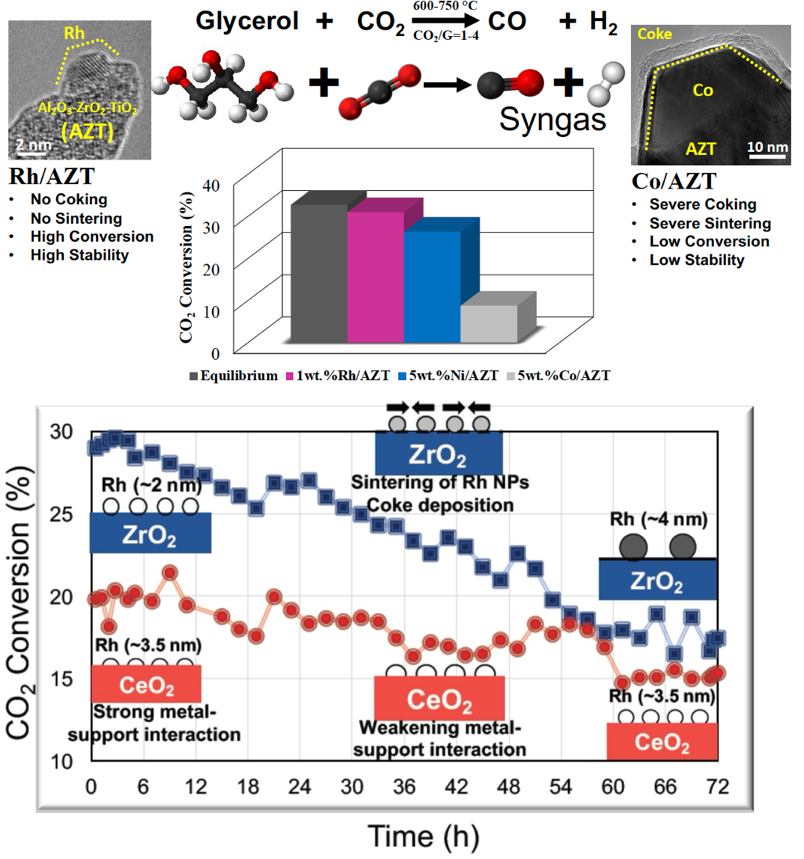
In SPICE we also carry out extensive studies on catalyst development and activity/stability testing. Recently, we carried out a series of studies in collaboration with Prof. Emrah Ozensoy’s research group to understand structure-activity relationships in the context of CO2 reforming of glycerol to synthesis gas. Glycerol is considered as an undesired side product of biodiesel synthesis and its valorization is essential to regulate the cost of making biodiesel. This unwanted waste is reformed with CO2 with the aim of obtaining a valuable product (syngas) from two unwanted reactants. The results, published in a series of impactful publications, show how the types of active metal and support material and the interaction between them affect the activity and stability characteristics of the resulting catalysts. One of these publications (please refer to the end of this document) is particularly important as it is the debut publication that is built on the data collected at the Synchrotron-light for Experimental Science and Applications in the Middle East (SESAME) and featured in Nature Asia (https://www.natureasia.com/en/nmiddleeast/article/10.1038/nmiddleeast.2019.90).

Last but not the least: Electrification! With the increasing availability of renewable power, research on the integration of catalysis, electrification and reaction engineering will gain more interest. In SPICE, we now direct our focus on electrifying the reactors by induction which offers hundreds of degrees of temperature increase in the order of seconds. In addition to offering isothermal operation, very fast and uniform heating through electrification will be an important milestone in clearing out the dependence of fossil fuel based heating and nullifying the carbon footprint of the catalytic reactors.
Want to join us for unraveling the grand challenges of sustainable catalysis and reaction engineering? Just send an e-mail: avciahme@bogazici.edu.tr
SELECTED PUBLICATIONS
(Complete list available from https://scholar.google.com/citations?hl=en&user=NFQMSzUAAAAJ&view_op=list_works&sortby=pubdate)
Heat-exchange integrated microreactors / computational:
- Ozturk, N.F., Avci, A.K., “Intensified dimethyl ether production from synthesis gas with CO2”, Chemical Engineering Journal, 370 (2019) 885-896
- Bac, S., Avci, A.K., “Ethylene oxide synthesis in a wall-coated microchannel reactor with integrated cooling”, Chemical Engineering Journal, 377 (2019) 120104
Membrane microchannel reactors / computational:
- Kucuk, E., Koybasi, H.H., Avci, A.K., “Beyond equilibrium ammonia synthesis in a membrane and heat exchange integrated microreactor: A modeling study”, Fuel, 357 Part B (2024) 129858
- Ince, M.C., Koybasi, H.H., Avci, A.K., “Modeling of reverse water–gas shift reaction in a membrane integrated microreactor”, Catalysis Today, 418 (2023) 114130
- Koybasi, H.H., Avci, A.K., “Numerical analysis of CO2-to-DME conversion in a membrane microchannel reactor”, Industrial & Engineering Chemistry Research, 61 (30) (2022) 10846-10859
Microchannel reactors / experimental:
- Koc, S., Avci, A.K., “Reforming of glycerol to hydrogen over Ni-based catalysts in a microchannel reactor”, Fuel Processing Technology, 156 (2017) 357-365
- Simsek E, Avci, A.K., Onsan, Z.I., “Investigation of catalyst performance and microstructured reactor configuration for syngas production by methane steam reforming”, Catalysis Today, 178 (2011) 157-163
Glycerol dry reforming / experimental:
- Selcuk, O, Caglayan, B.S., Avci, A.K., “Ni-catalyzed CO2 glycerol reforming to syngas: New insights on the evaluation of reaction and catalyst performance”, Journal of CO2 Utilization, 67 (2023) 102329.
- Ozden, M., Say, Z., Kocak, Y., Ercan, K.E., Jalal, A., Ozensoy, E., Avci, A.K., “A highly active and stable Ru catalyst for syngas production via glycerol dry reforming: Unraveling the interplay between support material and the active sites”, Applied Catalysis A: General, 636 (2022) 118577
- Bac, S., Say, Z., Kocak, Y., Ercan, K.E., Harfouche, M., Ozensoy, E., Avci, A.K., “Exceptionally active and stable catalysts for CO2 reforming of glycerol to syngas”, Applied Catalysis B: Environmental, 256 (2019) 117808
- Bulutoglu, P.S., Say, Z., Bac, S., Ozensoy, E., Avci, A.K., “Dry reforming of glycerol over Rh-based ceria and zirconia catalysts: New insights on catalyst activity and stability”, Applied Catalysis A: General, 564 (2018) 157-171.
Development of artificial intelligence and machine learning in brief: Part I
Compiled and Edited by Prof. Dr. N. Alper TAPAN
Artificial intelligence is more and more pronounced in the field of catalysis day by day since it has the power for the discovery of new catalytic materials for sustainable chemical processes. In this part, we have decided to introduce AI from historical perspective dating back to its origins.
The history of intelligent computing devices dates back to 1930 by Vannevar Bush when he developed an algorithm to solve differential equations. After that in 1936, Alan Turing who is founder of computer science developed a concept of CPU for solution of algorithms which is known as Turing Machine. He was famous with his Turing Test in 1950 based on the conversations between human and computer. During conversations if the machine is able to fake evaluator by imitation of human skills, it exhibits intelligent behavior. After this milestone, learning ability of computers were demonstrated by PC game checkers. The term “Artificial Intelligence” was first pronounced by John McCarthy at a conference in Dartmounth College in 1956. Basic building block of AI, perceptron was discovered by Rosenbaltt which lead to the concept of connectionism in a neural network. A somewhat concrete example of Turing test was ELIZA , an interactive computer program developed in MIT between 1964-1967. Although huge investments were made by DARPA, NRC etc. initially, during 1970’s, academia and industry lost interest in AI due to unavailable powerful processing devices at that time. But in 1980’s, expert systems were developed based on a database linked to rules engine communicating with non-expert through user interface. These systems were applied first to diagnose diseases and prescribe medicine. Rebirth of AI was through backpropagation technique used to train the neural network with the training database. Backpropagation is simply the use of training data set to update weights of neurons used activation functions iteratively for the minimization of error between observed (training) and the predicted output from neural network. Interest on expert systems were also diminished since they were not be able to mimic human skills such as learning, adapting and evolving based on different interactions with users. After determination of this weakness, new concepts such as “machine learning”, “intelligent systems”, “knowledge based systems” were seen to take the stage and shaped the future of AI [1]. There were leaps in the development of AI such as Deep Blue machine which defeated world champion Garry Kasparov in a six game match in 1996 and such as AlphaGo program developed by London based DeepMind Technologies which defeated Go (3000 year old game with a state space complexity of 10170) master Lee Sedol in 2016. An article was published in Nature in 2016 documenting the algorithm of AlphaGo as the featured cover article, which evidenced this epic achievement and milestone in AI [2].
In 2022, natural language processing (NPL) model, ChatGPT was developed by Open AI. It has consisted of 175 billion parameters reaching 1 million users in 5 days. Bard (named Gemini now) was developed by Google in 2023 with 137 billion parameters. Although there has been a debate about language understanding of these models like between Linguist Noam Chomsky and proponents of statistical models, today, numerous NPL models are being developed with different capabilities and enormous performances and today, the capability of AI as an entrepreneur, project manager is being discussed.
When we talk about AI, we mean integration of human intelligence and behavior with machines and advanced systems. In fact there are two main subsets of AI which are machine learning (ML) and deep learning (DL). Machine learning is a way of building models by learning from observed data through advanced algorithms. Today’s NLP models which are forms of generative AI ( AI which is able to generate different forms of visual, numerical or written information in response to the user input) were evolved from ML. Deep learning is inspired from information processing of human brain by neurons (data transmitters) connected by synapses and is an advanced programmed mathematical model involving layers of these interconnected neurons. These AI model subsets have close relationship with data science since they are trained by transformed and processed data from unstructured , noisy observations [3].
If we focus on machine learning, it was experienced that machine learning (ML) as an AI technique has a very high potential in different fields of research. You may come across with ML for instance in determination of key factors causing gas explosion accidents in coal mines [4] or for instance in prediction of energy consumption in OECD countries with 25 years of past socioeconomic data [5] or for instance determination of catalytic routes and most important variables for high conversion transesterification reaction [6].
Machine learning techniques can be classified into four groups such as supervised, unsupervised, semi-supervised and reinforcement learning. Supervised learning is based on training of the algorithm by labeled data and using trained algorithm for classification or prediction of output (regression). Naives Bayes, K-nearest neighbors, Support vector machines, Decision Trees, Ensemble learning, Random Forest, Linear regression, Support vector regression are some of the popular ML techniques that can be used to solve various supervised learning tasks. Unsupervised learning is based on exploration of observed data to reveal uncharted patterns, and relationships between features. For exploration of data, clustering, dimensional reduction, visualization, association rule , anomaly detection techniques can be used. Some of the most popular unsupervised learning algorithms are K-means, Apriori, Pearson Correlation, Principal component analysis. Semi-supervised learning is a hybrid technique which uses labeled and unlabeled data together to train the model. For instance, you may have data labeled as high conversion or you may have data which was not classified as high, medium or low conversion. Reinforcement learning used in this study is based on an agent that learns its strategies to reach optimum values by moving in an environment that is updated by gaining experience after taking and analyzing actions through Markov Decision Process. In reinforcement learning, different algorithms such as Monte Carlo learning, Q-learning, Deep Q Networks can be used.
Overall, ML as a powerful subdiscipline of AI can be seen on many facets of science and life, such as catalysis, healthcare (even ML approach was offered for delivering COVID-19 help), cybersecurity, business, education, virtual help, and smart cities [3]. As the learning capabilities of ML increase day by day with an enormous speed, we are likely to see accelerated discoveries of new catalysts, optimized catalytic processes with highest efficiencies and lowest costs ,high throughput screening of candidate materials for catalysis and likely to see increase in the speed of transition from lab scale discovery to industrial applications.
The following resources below can be used for further reading.
[1] Khan, F. H., Pasha, M. A., & Masud, S. (2021). Advancements in microprocessor architecture for ubiquitous AI—An overview on history, evolution, and upcoming challenges in AI implementation. Micromachines, 12(6), 665.
[2] Silver, D., Huang, A., Maddison, C. et al. Mastering the game of Go with deep neural networks and tree search. Nature 529, 484–489 (2016). https://doi.org/10.1038/nature16961
[3] Sarker, I. H. (2022). AI-based modeling: techniques, applications and research issues towards automation, intelligent and smart systems. SN Computer Science, 3(2), 158.
[4] Li, L., Guo, H., Cheng, L., Li, S., & Lin, H. (2022). Research on causes of coal mine gas explosion accidents based on association rule. Journal of Loss Prevention in the Process Industries, 80, 104879.
[5] Sen, D., Tunç, K. M., & Günay, M. E. (2021). Forecasting electricity consumption of OECD countries: A global machine learning modeling approach. Utilities policy, 70, 101222.
[6] Alper Tapan, N., Yıldırım, R., & Erdem Günay, M. (2016). Analysis of past experimental data in literature to determine conditions for high performance in biodiesel production. Biofuels, Bioproducts and Biorefining, 10(4), 422-434.
Recent Selected Papers in our Catalysis Community
In recent months, there have been exciting research studies in catalysis research in Turkey. Here are the short summaries:
Density Functional Theory(DFT) Studies
Kızılkaya, A. C. (2024). Design of Sulfur Resistant Cobalt Catalysts by Boron Promotion: Atomic Scale Insights. Sakarya University Journal of Science, 28(3), 531-541.
The effect of boron promotion on atomic sulfur formation by hydrogen sulfide dissociation on Co(111) was studied using Density Functional Theory calculations. The results indicate that on clean Co(111), hydrogen sulfide dissociates quickly, producing atomic sulfur on the cobalt surface, while boron increases activation barriers and prevents sulfur compounds from interacting with cobalt. Thus, boron acts as an effective promoter for designing sulfur-resistant cobalt catalysts.
Desulfurization catalysts
Bulut, B., Atakül, H., Aksoylu, A. E., & Tantekin-Ersolmaz, Ş. B. (2024). Deep adsorptive desulfurization of liquefied petroleum gas over Cu ion-exchanged Y zeolite. Separation and Purification Technology, 338, 126431.
Deep desulfurization of fuels is essential to reduce sulfur oxide emissions, which cause smog, global warming, and acid rain. A copper-modified Y zeolite (Cu-Y) adsorbent was developed for removing dimethyl disulfide (DMDS) and thiophene (TP) from liquefied petroleum gas (LPG), showing significantly higher adsorption capacities compared to the original NaY zeolite. The Cu-Y zeolite, prepared by liquid phase ion-exchange and calcined at 550°C, maintained its adsorption capacity over multiple regeneration cycles, making it a practical solution for sulfur removal in LPG.
Machine learning in catalysis
Gulbalkan, H. C., Uzun, A., & Keskin, S. (2024). Combining computational screening and machine learning to explore MOFs and COFs for methane purification. Applied Physics Letters, 124(20).
Metal-organic frameworks (MOFs) and covalent organic frameworks (COFs) show great potential for high-performance methane purification as porous adsorbents and membranes. High-throughput computational screening, using molecular simulations and machine learning, has become essential for efficiently evaluating and discovering the most promising MOFs and COFs from an ever-growing number of materials. Recent advancements in combining data science with molecular simulations have accelerated the identification of optimal materials and revealed hidden structure-performance relationships, providing significant opportunities for the design and discovery of effective adsorbent and membrane materials
Photocatalysis and photoelectrocatalysis
Turbedaroglu, O., Kubanaliev, T., Alemdar, S., Eroglu, Z., Kilic, H., & Metin, O. (2024). Reduced Graphene Oxide/Few-Layer Phosphorene Binary Heterojunctions as Metal-Free Photocatalysts for the Sustainable Photoredox C–H Arylation of Heteroarenes. ACS Sustainable Chemistry & Engineering, 12(9), 3659-3670.
Few-layer phosphorene (FLP)/reduced graphene oxide (rGO) binary heterojunctions were fabricated as metal-free photocatalysts for direct C−H arylation of heteroarenes under visible light. These heterojunctions demonstrated enhanced stability, charge separation efficiency, and extended charge transfer ability, with the optimal catalyst containing 30% FLP achieving high photocatalytic efficiency, particularly with electron-withdrawing aryl diazonium salts. The FLP/rGO catalysts were reusable, maintaining high activity over five cycles, and successfully applied in synthesizing the drug dantrolene, highlighting their potential in synthetic chemistry and pharmaceutical applications.
Eroglu, Z., Ozer, M. S., & Metin, Ö. (2024). Nitrogen‐Based Imperfections in Graphitic Carbon Nitride–New Trend for Enhancing Photocatalytic Activity?. ChemCatChem, e202301560.
This review delves into the engineering of nitrogen vacancies (N-vacancies) in polymeric carbon nitride (CN) and their significant impact on CN's photocatalytic applications. Creating N-vacancies by removing targeted nitrogen atoms is crucial for enhancing CN's photocatalytic properties, including increased surface areas and substrate interactions. The review also covers synthesis strategies, such as thermal treatments, and advanced characterization techniques, highlighting how defect engineering in CN can tune bandgaps, form midgap states, and create active sites, thereby designing new-generation photocatalysts with tailored functionalities.
Bienkowski, K., Solarska, R., Trinh, L., Widera-Kalinowska, J., Al-Anesi, B., Liu, M., ... & Yıldırım, R. (2024). Halide Perovskites for Photoelectrochemical Water Splitting and CO2 Reduction: Challenges and Opportunities. ACS catalysis, 14(9), 6603-6622.
Photoelectrochemical water splitting and CO2 reduction offer a promising way to produce solar fuels while reducing CO2 emissions, with metal halide perovskites (MHPs) being extensively studied for their suitable optoelectronic properties. This review discusses recent achievements in MHP-based photoelectrochemical processes, including advances in performance and strategies to address toxicity and instability issues, such as replacing toxic Pb with less harmful elements and improving water stability through various engineering methods. Additionally, the review emphasizes the importance of improving stability as a major challenge and highlights the potential of machine learning to optimize halide perovskite formulations for desired properties.
Platinum dual atom catalysts
Mekkering, M. J., Laan, P. C., Troglia, A., Bliem, R., Kizilkaya, A. C., Rothenberg, G., & Yan, N. (2024). Bottom-Up Synthesis of Platinum Dual-Atom Catalysts on Cerium Oxide. ACS Catalysis, 14, 9850-9859.
We synthesized and evaluated dual-atom catalysts (DACs), which feature pairs of metal atoms and offer additional binding possibilities compared to single-atom catalysts (SACs). Using an automated bubble counter setup, we compared the catalytic performance of ceria-supported platinum SACs and DACs in ammonia borane hydrolysis, finding that DACs enhance the reaction rate threefold and enable faster reactions at lower temperatures due to preorganization of reactants at the dual-atom site. This study suggests that DACs improve water−O−H bond activation and hydrogen spillover effects, providing new insights into hydrogen spillover mechanisms beyond what is known from CO oxidation studies.
Upcoming Catalysis Events
- 62 days left to 7th Anatolian School of Catalysis (Date: 01-05/09/2024)
Don’t forget to register and check out updated web page below!!
Sponsored by European Federation of Catalysis (EFCATS)!!
Web site: https://meetinghand.com/e/7th-anatolian-school-of-catalysis-asc-7/
- The 35th National Chemistry Congress with special session on Catalysis (Date: 09-12/09/2024)
Web site: https://kimya2024.com/
Don't miss out! Register now for these events and be part of the catalysis community.

Signs of chaos in catalysis
Like in nature, human lives, and biological systems, we can see signs of chaos in catalytic transformations. One sign is compartmentalization. Compartmentalization is the separation of a system into distinct regions of local environments and reactions in parallel without interference. Parallel reaction environments communicate by different mechanisms and oscillate for instance in microemulsions, droplets, and gels. Although separated systems are in close proximity, they are incompatible, like in the case of two different metal-oxide interfaces in a core-shell structure. The compartmentalization of catalytic systems is studied by observation of oscillations, multistabilities, or Turing patterns (which demonstrate instabilities due to variations in diffusion and reaction of chemical species in the same environment). For instance, on a polycrystalline metal surface, individual crystalline structures exhibit multi-frequential oscillations, multi-states, and frequency transformations. Another example is in nanoparticles (hard workers in catalysis) with different nanocompartments, such as differently oriented nanofacets separated by atomic-size ridges. And each nanofacet is an individual reaction packet. Compartmentalization as a sign of chaotic behavior was studied by theoretical simulations and also observed during different reactions such as H2 oxidation or CO oxidation on Rh and Pt crystal surfaces by field ion microscopy (FIM) or field emission microscopy (FEM).
Raab, M., Zeininger, J., Suchorski, Y. et al. Emergence of chaos in a compartmentalized catalytic reaction nanosystem. Nat Commun 14, 736 (2023). https://doi.org/10.1038/s41467-023-36434-y
Last months’s puzzle
1)KUHyTech:This center in Koç University focuses on research of new materials and systems for hydrogen production, storage, and utilization.
2)UZUNLAB: The goal of this Koç University laboratory is to create materials for gas storage and separation, as well as for the conversion of hydrocarbons into valuable fuels. To comprehend structure-performance correlations, their methodology combines meticulous material synthesis and characterization with in-depth performance experimentation.
3)AMMONIA:plasma synthesis of this molecule from water and N2 can be performed by silica supported catalysts
4)PROLINE: type of assymetric catalyst studied by Benjamin List of the Max Planck Institute for Kohlenforschung, and David W. C. MacMillan of Princeton University who win 2021 Nobel prize on asymmetric organocatalysis.
5)DES: abbreviation of adjustable solutions of Brønsted or Lewis acids and bases that result in eutectic mixtures. They have wide-range uses in electrochemical, separation, and catalytic processes.
6)SOFC: abbreviation of energy converter based on transport of oxygen anions and ceramic ion conductors.
7)BROWNIAN: This motion was invented by Einstein in 1905 which enlights how molecules transfer energy in liquid and gas phase.
8)OPERANDO:a method of analysis where the evaluation of catalytic activity and selectivity is combined with spectroscopic characterisation of materials undergoing reaction.